

Why is choosing the right panel crucial?
Solar panels make up the largest and most important part of any photovoltaic power plant. The choice of technology directly impacts the overall efficiency, investment cost, long-term yields, and the appearance of your roof. Although all panels perform the same function – converting solar energy into electricity – the differences between them are substantial.
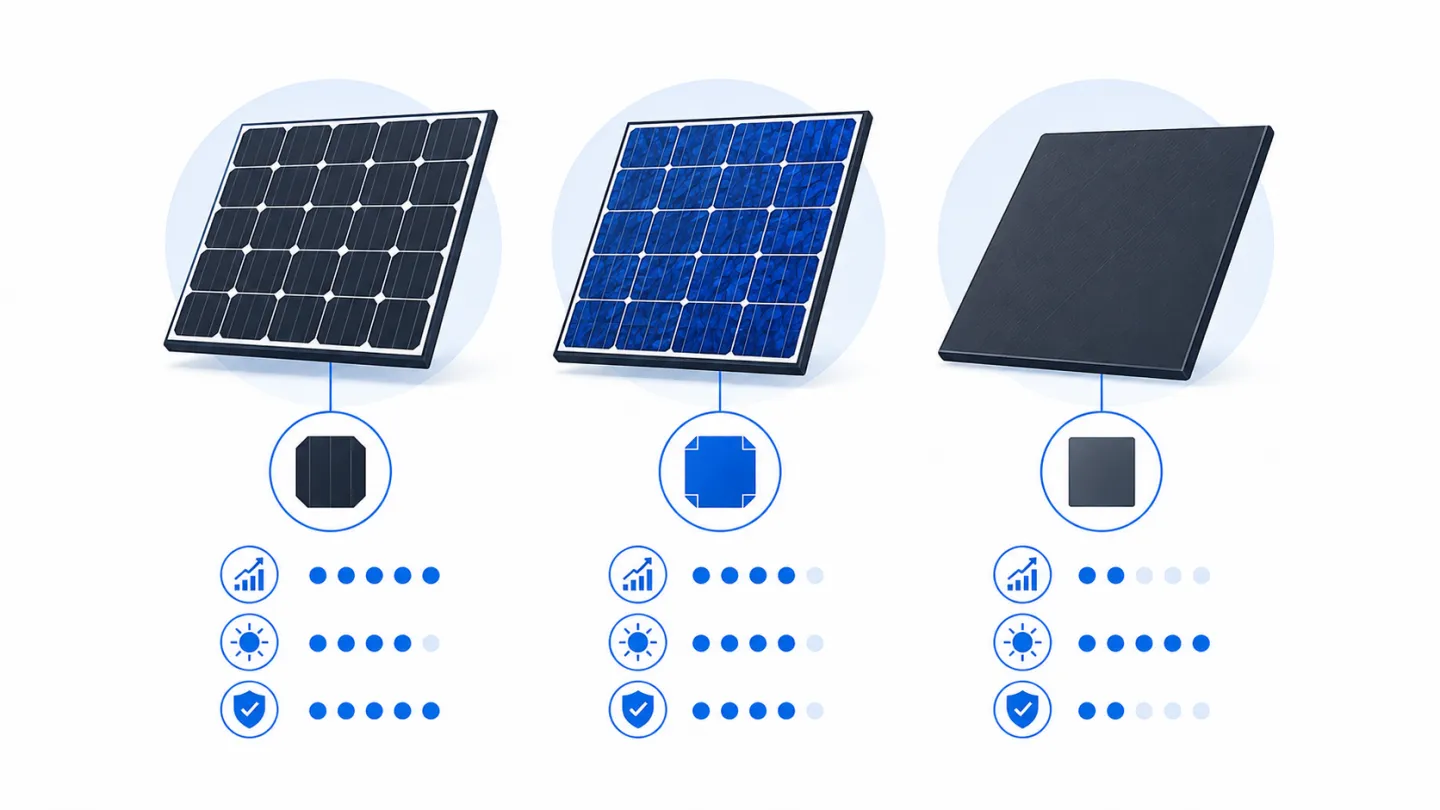
The three main categories on the market are:
- monocrystalline,
- polycrystalline,
- thin-film panels.
In this guide, we explain how they work, where they are used, and which ones are best for residential solar power plants.
Monocrystalline Solar Panels – Highest Efficiency and Modern Appearance
Monocrystalline panels are made from a single silicon crystal, which allows for a highly regular atomic structure and exceptionally good conductivity.
Advantages:
- Highest efficiency on the market (18–23%)
- Excellent performance in low-light conditions
- Sleek dark appearance (black panels)
- Ideal for smaller roofs due to higher yield per square meter
Disadvantages:
- Highest price compared to other types
- Higher temperature sensitivity compared to thin-film panels
Best for:
Homeowners with limited roof surface area who want maximum yield and long-term durability.
Polycrystalline Solar Panels – A More Affordable and Solid Option
Polycrystalline panels consist of multiple smaller silicon crystals melted together into a single unit. They are easily recognizable by their lighter, bluish tint.
Advantages:
- Lower price compared to monocrystalline panels
- Stable performance and reliability
- A good option for projects where space is not a limiting factor
Disadvantages:
- Efficiency of 15–18% (noticeably lower than monocrystalline panels)
- Larger surface area required to achieve the same yield
- Visually/Aesthetically less attractive
Best for:
Roofs or ground areas where space is readily available and when a more affordable price is the priority.
Thin-Film Panels – Flexibility, Lightweight, and Special Applications
Thin-film solar panels are manufactured by depositing thin layers of photovoltaic material onto glass, plastic, or metal. The most common types are a-Si, CdTe, and CIGS.
Advantages:
- Extremely lightweight and flexible
- Perform well at high temperatures
- Efficient in diffuse light (fog, cloudy weather)
- Can be installed on surfaces unsuitable for rigid panels
Disadvantages:
- Lowest efficiency (10–13%)
- Requires significantly more surface area for the same yield
- Less suitable for typical households
Best for:
Special applications:
- industrial halls with large roofs
- structures with low weight-bearing tolerance
- mobile or temporary systems
Comparison by Key Criteria
Criterion |
Monocrystalline |
Polycrystalline |
Thin-Film |
|---|---|---|---|
Efficiency |
⭐⭐⭐⭐⭐ |
⭐⭐⭐ |
⭐⭐ |
Price |
💰💰💰 |
💰💰 |
💰 |
Required Surface Area |
Smallest |
Medium |
Largest |
Appearance |
Sleek, black |
Bluish |
Varies |
Ideal For |
Houses, smaller roofs |
Larger roof areas |
Special applications |
Which type of panel should you choose?
If you are building a residential photovoltaic power plant, in 90% of cases, monocrystalline panels are the best choice due to their high yield and long-term profitability.
Polycrystalline panels are a good compromise option when the budget is limited, while thin-film panels are ideal only for very specific conditions.
Quick selection tip:
- Limited space? → Monocrystalline
- Large surface area? → Polycrystalline
- Special technological needs? → Thin-film
Conclusion: Investing in Quality Pays Off
The choice of panels directly affects the overall efficiency of the power plant and the return on investment. Although monocrystalline panels require slightly higher initial investments, their long-term advantage in yield and aesthetics usually outweighs the difference in price.
For homeowners who want the best combination of power, durability, and appearance, monocrystalline panels remain the leading choice.